
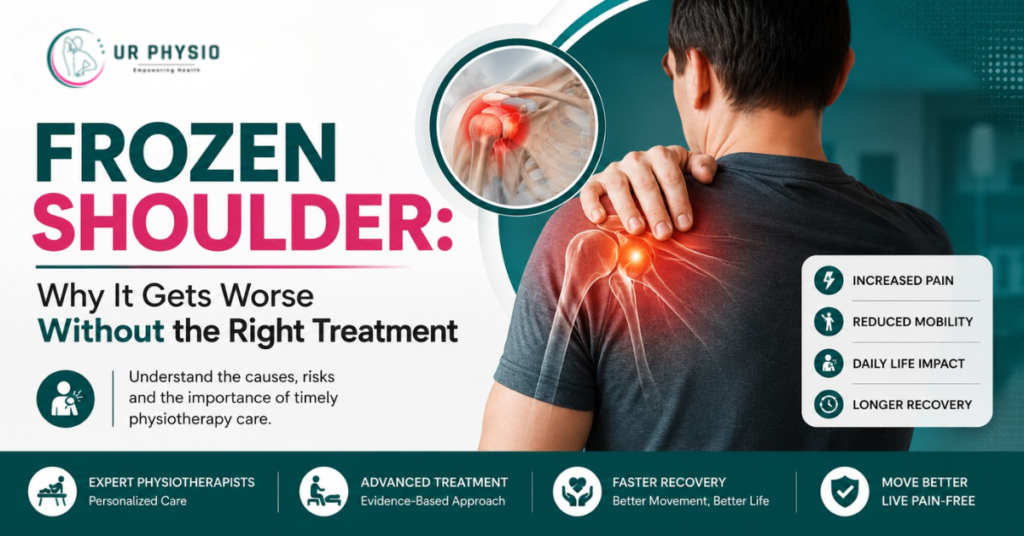
It starts innocently. A mild ache in the shoulder when you reach up for something on a high shelf. A slight stiffness when you try to put on your shirt in the morning. Most people do what most people do — they rest it, apply a hot water bag, and assume it will pass.
A few weeks later, the pain is worse. A few months later, they cannot lift their arm above shoulder height. They can’t fasten a bra clasp behind their back. They can’t sleep on that side without waking up in pain. Combing their hair has become a two-handed operation.
This is frozen shoulder — and this is precisely how it progresses when it goes untreated.
I see this at my physiotherapy clinic in Jaipur every week. Patients who were told “just rest it” or “it will go on its own” arrive six months later with a shoulder that is essentially locked in place. What could have been managed in three to four months now takes the better part of a year.
This blog explains exactly what frozen shoulder is, why it gets progressively worse without the right shoulder pain treatment, and how physiotherapy service in Jaipur can not only stop that progression but restore your shoulder’s full function.
What Is Frozen Shoulder?
Frozen shoulder, clinically known as adhesive capsulitis, is a condition in which the tissue capsule surrounding the shoulder joint — a structure called the glenohumeral capsule — becomes inflamed, thickened, and then scarred, causing it to tighten around the joint.
The result is a shoulder that is painful, progressively stiff, and eventually almost immobile — “frozen” in place.
It is not caused by an injury. It is not arthritis. It is not a muscle problem. It is a specific disease of the shoulder capsule, and understanding that distinction matters because it changes how it should be treated.
Frozen shoulder is more common than most people realise. It affects roughly 2–5% of the general population and is significantly more common in:
- Women between 40 and 60 years of age
- People with diabetes — frozen shoulder is 3–4 times more common in diabetics and tends to be more severe and longer-lasting
- People who have recently had shoulder surgery, a fracture, or a stroke — immobility after any of these can trigger it
- People with thyroid disorders
- Those who have kept the shoulder still for weeks after an injury, even an injury elsewhere (like a wrist fracture where the arm was in a sling)
If you have diabetes and shoulder stiffness, this is especially urgent — do not wait.
The Three Stages: Why It Gets Worse If You Wait
This is the crucial thing most patients don’t know: frozen shoulder has three distinct stages, and leaving it untreated doesn’t freeze it in place — it pushes it into the next, worse stage.
Stage 1: The Freezing Stage (3–9 months)
This is when the inflammation begins. The shoulder hurts with any movement — reaching up, reaching behind you, lifting anything to the side. The pain is often worse at night, interrupting sleep. Range of motion starts to reduce.
At this stage, many people assume it is a muscle strain or a “pulled something.” They rest, take painkillers, and wait. This is the most costly mistake.
What’s happening inside: The capsule is inflaming. Scar tissue is beginning to form. Aggressive movement at this point can worsen inflammation — but the right physiotherapy service in Jaipur works with the biology of this stage: reducing inflammation, relieving pain, and preventing the capsule from tightening further.
If treatment begins here, recovery time is significantly shorter. The freezing can be slowed. Some patients never fully enter Stage 2.
Stage 2: The Frozen Stage (4–12 months)
The pain may actually reduce slightly at this point — which fools many people into thinking they’re getting better. They’re not. The shoulder is now substantially stiffer. Range of motion has reduced significantly in all directions. Dressing, hair care, and reaching across the body become genuinely difficult tasks.
What’s happening inside: The capsule has thickened and contracted. Scar tissue — called adhesions — has formed inside the joint. The space inside the shoulder has narrowed dramatically.
Physiotherapy in Jaipur at this stage focuses on mobilising the joint, stretching the capsule, and breaking down adhesions through specific manual techniques. This is demanding work, but it is effective. Skipping it means the adhesions consolidate and become increasingly resistant to treatment.
Stage 3: The Thawing Stage (6 months – 2 years)
Movement begins to slowly return. Pain reduces further. But if the joint has been left without physiotherapy through stages 1 and 2, the scar tissue is now dense, the muscles around the shoulder have weakened from disuse, and the body has developed compensatory movement patterns (using the neck and upper back to do what the shoulder should be doing) that create their own secondary problems.
Recovery in this stage without prior physiotherapy is slow, incomplete, and frustrating. With structured shoulder pain treatment at a physiotherapy clinic in Jaipur, recovery is measurably faster and more complete.
Without any treatment, frozen shoulder can last 2–3 years. With proper physiotherapy, most patients achieve full or near-full recovery in 6–12 months. That is not a small difference — it is 12 to 18 months of your life.
Why “Just Resting It” Makes Frozen Shoulder Worse
This is worth saying clearly, because it runs counter to most people’s instinct.
Rest is the wrong treatment for frozen shoulder.
When the shoulder is kept still — whether from pain, fear of movement, or bad advice — several things happen:
- The capsule tightens further. Movement, done correctly and in the right amount, is what prevents the capsule from contracting. Without it, the scarring progresses faster.
- The surrounding muscles weaken and atrophy. The rotator cuff muscles, deltoid, and scapular stabilisers all lose strength rapidly with disuse. This makes recovery harder even after the capsule begins to loosen.
- Compensation patterns develop. When the shoulder doesn’t move, the neck, upper back, and the other shoulder start doing its work. This leads to secondary neck pain, upper back stiffness, and sometimes nerve-related symptoms like tingling in the arm.
- The window for easier treatment closes. Stage 1 is the most treatable stage. Every week of inaction pushes the shoulder deeper into Stage 2.
How Physiotherapy Service in Jaipur Treats Frozen Shoulder
At our physiotherapy clinic in Jaipur, frozen shoulder is treated with a structured, stage-specific protocol. There is no single treatment that works at all stages — the approach changes as the shoulder changes.
Pain Relief First (Stage 1 Focus)
In the freezing stage, the priority is managing pain and inflammation so that the patient can participate in treatment without aggravating the condition. Physiotherapy modalities used include:
- Ultrasound therapy — deep tissue sound waves that reduce inflammation within the capsule at a level no topical application can reach
- Short wave diathermy — generates gentle therapeutic heat deep within the joint, improving blood flow and reducing pain
- TENS (Transcutaneous Electrical Nerve Stimulation) — interrupts pain signals, providing meaningful relief that makes further treatment possible
- Hot packs and cryotherapy — used strategically depending on whether the dominant issue is inflammation (cold) or stiffness (heat)
Joint Mobilisation — The Core of Recovery
This is the most important part of frozen shoulder treatment in Jaipur and the element that separates physiotherapy from just “rest and painkillers.”
Maitland and Mulligan mobilisation techniques involve applying precise, graded movements to the shoulder joint — movements that stretch the capsule, break down early adhesions, and restore mobility incrementally. These are not exercises the patient does at home. They are hands-on techniques performed by a trained physiotherapist, and they directly address the structural cause of the restriction.
At Stage 2, these techniques become more sustained and progressive. The physiotherapist works systematically to restore external rotation first (the most restricted movement in frozen shoulder), then abduction, then internal rotation.
Targeted Shoulder Exercises
As pain decreases and range of motion begins to improve, a graded home exercise programme is introduced. This typically includes:
- Pendulum exercises — using the weight of the arm to gently mobilise the joint without active muscle effort
- Assisted range-of-motion exercises — using the unaffected arm or a stick to guide the shoulder through its range without forcing it
- Posterior capsule stretches — specifically targeting the tightened back portion of the capsule
- Rotator cuff and scapular stabiliser strengthening — rebuilding the muscles that have weakened during the frozen period
These exercises are not generic. A good physiotherapy service in Jaipur prescribes exercises specific to your stage, your restriction pattern, and your pain threshold. The wrong exercises at the wrong stage can genuinely set recovery back.
Postural Correction and Secondary Problem Management
By the time most patients arrive at our physiotherapy clinic in Jaipur, they have been compensating with their neck and upper back for months. Addressing these secondary issues — cervical stiffness, upper trapezius tightness, scapular winging — is part of a complete shoulder pain treatment plan. Treating the shoulder in isolation without addressing what the rest of the body has been doing is an incomplete approach.
When Is Surgery Considered?
A small number of frozen shoulder cases — those that have not responded to 4–6 months of intensive, well-executed physiotherapy — may be considered for a procedure called Manipulation Under Anaesthesia (MUA) or hydrodilatation (injecting fluid into the joint to expand the capsule).
These are not first-line treatments. And here is what most patients are not told: even after these procedures, physiotherapy is essential. Without it, the shoulder frequently re-freezes. The procedure creates the opening; physiotherapy is what consolidates the recovery.
If you have been told you need MUA without having received a proper course of physiotherapy in Jaipur first, a second opinion is strongly advisable.
Frozen Shoulder in Diabetic Patients — A Special Note
If you have diabetes and are experiencing shoulder stiffness, please do not wait.
Diabetic frozen shoulder is more severe, progresses faster, affects both shoulders more commonly, and takes longer to resolve than non-diabetic frozen shoulder. Blood sugar control directly affects recovery — patients with poorly controlled diabetes respond more slowly to all treatments, including physiotherapy.
At our physiotherapy service in Jaipur, we work closely with diabetic patients on a modified protocol that accounts for nerve sensitivity, slower tissue healing, and the need for more frequent sessions. Early intervention in this group is not just advisable — it is essential.
What Patients in Jaipur Should Know
Frozen shoulder is particularly common among women in Jaipur between 40 and 60 — a demographic that often delays treatment because of family commitments, a belief that the pain will pass, or lack of awareness that effective treatment exists.
It does exist. You do not have to wait 2–3 years for a frozen shoulder to “resolve on its own” — especially when that resolution is often incomplete.
At UR Physio Clinic, Murlipura, we offer:
- Dedicated shoulder pain treatment in Jaipur with a structured, stage-specific protocol
- Home visit physiotherapy for patients who cannot travel due to severe pain or mobility limitations
- Women’s physiotherapy services with a female physiotherapist for patients who prefer it
The earlier you begin, the shorter the recovery. A shoulder that has been frozen for 3 months is significantly easier to treat than one that has been frozen for 12.
Summary: What to Do If You Think You Have Frozen Shoulder
- Don’t ignore persistent shoulder pain or stiffness — especially if it has lasted more than 4 weeks
- Don’t rely only on painkillers — they manage symptoms but do nothing to address the capsular inflammation or scarring
- Don’t rest it completely — controlled movement, guided by a physiotherapist, is essential to prevent progression
- Do get a clinical assessment — not just an X-ray, but a hands-on evaluation of your shoulder’s range of motion, pain pattern, and stage of condition
- Do start physiotherapy as early as possible — the evidence is clear that early intervention leads to faster, more complete recovery
Dr. Suman is the lead physiotherapist at UR Physio Clinic, Murlipura, Jaipur. The clinic provides specialist physiotherapy service in Jaipur for shoulder pain, back pain, knee conditions, neurological rehabilitation, and women’s physiotherapy, with home visit services available.
Book your shoulder assessment: +91 7878004780
UR Physio Clinic, Murlipura, Jaipur
🌐 jaipur.urphysio.in
Related reads:
- Back Pain Without Surgery: How Physiotherapy Actually Works
- Knee Pain After 40 — Arthritis vs. Injury (and What to Do)
Frequently Asked Questions about physiotherapy
Q1. What is frozen shoulder and how is it different from a rotator cuff injury?
Frozen shoulder (adhesive capsulitis) is a disease of the shoulder joint capsule — the tissue surrounding the joint becomes inflamed, thickened, and scarred, progressively restricting movement. A rotator cuff injury involves the muscles or tendons around the shoulder, not the capsule itself. The pain patterns, movement restrictions, and treatments are different. Rotator cuff pain is usually linked to specific movements (lifting, reaching overhead), while frozen shoulder restricts movement equally in almost all directions. A physiotherapy assessment can distinguish between the two clearly.
Q2. How long does frozen shoulder last without treatment?
Without treatment, frozen shoulder typically lasts between 18 months and 3 years, and in some cases, patients never regain full mobility. With structured physiotherapy service in Jaipur started at the right stage, most patients recover in 6–12 months. Early treatment does not just speed up recovery — it also prevents the condition from progressing into the more severe frozen stage.
Q3. Can frozen shoulder heal on its own without physiotherapy?
Technically, frozen shoulder is considered a self-limiting condition — meaning it can resolve without treatment eventually. However, “eventually” can mean 2–3 years, the recovery is often incomplete (with lasting stiffness), and the condition frequently causes secondary problems in the neck and upper back from compensation. Physiotherapy dramatically reduces recovery time and significantly improves the completeness of recovery. Waiting it out is not a clinically advisable strategy.
Q4. Is physiotherapy painful for frozen shoulder?
Physiotherapy for frozen shoulder can be uncomfortable, particularly in the frozen stage when the joint is stiff and the capsule is tight. A skilled physiotherapist at a physiotherapy clinic in Jaipur works within your pain tolerance — mobilisation techniques are graded carefully to stretch the capsule without aggravating inflammation. Some post-session soreness is normal and expected. Sharp, lasting pain after a session is a signal to communicate to your physiotherapist so the intensity can be adjusted.
Q5. How many physiotherapy sessions are needed for frozen shoulder?
This depends on the stage at which treatment begins. As a general guide:
- Stage 1 (early): 8–12 sessions over 6–8 weeks
- Stage 2 (frozen): 12–20 sessions over 3–5 months
- Stage 3 (thawing): 8–14 sessions over 6–10 weeks
Home exercises done consistently between sessions are equally important. Patients who complete their home programme recover faster than those who rely only on clinic sessions.
Q6. I have diabetes and shoulder stiffness. Is that related?
Yes, very likely. Diabetic frozen shoulder is a well-documented condition — people with diabetes are 3–4 times more likely to develop frozen shoulder than the general population. It also tends to be more severe, affects both shoulders more commonly, and takes longer to recover. Poor blood sugar control slows healing and reduces the effectiveness of physiotherapy. If you have diabetes and shoulder stiffness lasting more than a few weeks, seeking shoulder pain treatment in Jaipur as early as possible is strongly advisable.
Q7. Can I do exercises at home without seeing a physiotherapist?
Home exercises play an important role in frozen shoulder recovery — but they need to be the right exercises for the right stage. Generic exercises found online may be appropriate for one stage but counterproductive in another. For example, aggressive stretching during the active inflammation of Stage 1 can worsen the condition. A physiotherapist will assess your stage, prescribe specific exercises, and teach you how to perform them correctly before you continue them at home.
Q8. What is the difference between frozen shoulder and shoulder arthritis?
Shoulder arthritis is degeneration of the cartilage within the shoulder joint — similar to knee arthritis — and typically causes pain with specific movements and a grinding sensation. Frozen shoulder involves no cartilage damage; the joint surface is intact. The problem is the capsule around the joint. Shoulder arthritis is more common in people over 60 with a history of shoulder injuries. Frozen shoulder typically affects people between 40 and 60 with no specific trauma history. Both respond to physiotherapy, but the treatment approach is different.
Q9. Is there any injection or surgery for frozen shoulder?
Yes. Corticosteroid injections can reduce inflammation and are sometimes used alongside physiotherapy in the early stage. Hydrodilatation (injecting fluid to expand the capsule) is used in some cases. Manipulation Under Anaesthesia (MUA) — where the shoulder is forcibly stretched under general anaesthesia — is occasionally indicated for severe Stage 2 cases that haven’t responded to physiotherapy. However, none of these are first-line treatments, and all of them require physiotherapy after the procedure to maintain and build on the gains achieved. Surgery without follow-up physiotherapy in Jaipur frequently results in re-freezing.
Q10. Can UR Physio Clinic treat frozen shoulder at home in Jaipur?
Yes. UR Physio Clinic, Murlipura offers home visit physiotherapy in Jaipur for patients who are unable to travel due to severe shoulder pain, mobility limitations, or personal circumstances. Home visit treatment includes manual therapy, electrotherapy modalities (where portable equipment is available), and supervised exercise. For patients in the severe frozen stage, home visits can be particularly valuable in the early weeks of treatment before sufficient mobility is regained to travel comfortably. Call +91 7878004780 to arrange a home visit assessment.