
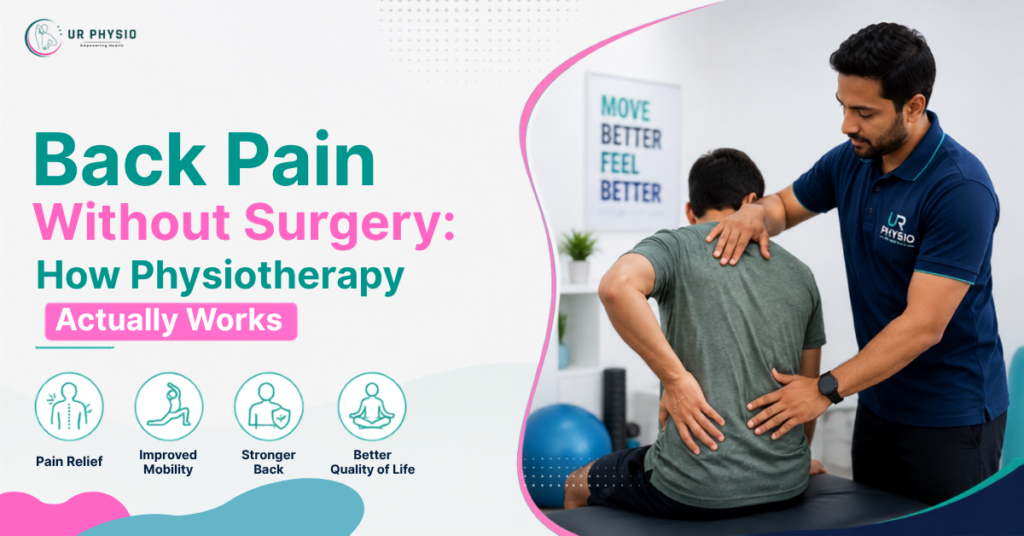
Every week, patients walk into my clinic carrying the same fear: “Doctor, do I need surgery?”
They’ve been dealing with back pain for months — sometimes years. They’ve tried painkillers, hot water bags, rest, and advice from well-meaning relatives. Some have been told by someone that their MRI looks “serious.” A few have already been advised surgery by someone else.
And almost every single one of them does not need surgery.
I’m not saying surgery is never the answer. For a very small number of people, it is. But for the vast majority — back pain physiotherapy is not just an alternative to surgery. It is the right first treatment.
This blog explains exactly how physiotherapy works for back pain, what happens session by session, and why it has such a strong track record even for conditions that sound scary on paper.
Why Does Your Back Hurt? (And Why That MRI May Be Misleading You)
Before we talk about treatment, let’s talk about something that causes a lot of unnecessary panic: the MRI report.
If you’re over 35 and you get an MRI of your spine, there is a good chance it will say something like “mild disc bulge at L4-L5” or “early degenerative changes.” This sounds alarming. It isn’t, necessarily.
Studies have consistently shown that disc bulges, mild degeneration, and even small herniations show up in people who have zero pain. These are often normal signs of aging — like grey hair or reading glasses. The finding on the scan doesn’t automatically explain your pain, and it certainly doesn’t automatically mean you need surgery.
What actually causes your pain is usually one or more of these:
- Muscle imbalances — Some muscles are overworked and tight, others are weak and underused. This puts uneven load on your spine.
- Poor posture habits — Hours of sitting, slouching at a desk, or looking down at a phone trains your body into positions it was never designed to hold for long.
- Joint stiffness — The small joints in your spine (facet joints) can become stiff and irritated, especially with age or inactivity.
- Nerve irritation — When a disc presses on a nerve, you can feel shooting pain, tingling, or numbness down your leg (this is called sciatica). Physiotherapy addresses this very effectively.
- Weak core muscles — Your “core” isn’t just your abs. It’s a group of deep muscles that act like a natural corset around your spine. When they’re weak, your spine absorbs far more stress than it should.
The good news: every single one of these is treatable with physiotherapy. No surgery required.
What Is Back Pain Physiotherapy, Really?

Most people think physiotherapy means hot packs and a few generic exercises. That’s a bit like thinking a dental visit is just a rinse and a toothbrush.
Modern back pain physiotherapy is a structured, clinical process. Here’s what it actually involves:
1. A Proper Assessment First
Before any treatment begins, your physiotherapist does a detailed evaluation. At UR Physio, this includes:
- Understanding how and when your pain started
- Identifying movements that aggravate or relieve pain
- Assessing your posture, spine alignment, and muscle strength
- Testing nerve function if sciatica or radiating pain is present
- Reviewing your MRI or X-ray reports in context of your actual symptoms
This matters because two people with “back pain” can have completely different problems that need completely different treatments.
2. Manual Therapy (Hands-On Treatment)
This is the part of physiotherapy that most people don’t know about — and often find the most immediately relieving.
Manual therapy includes:
- Joint mobilisation — Gentle, specific movements applied to stiff spinal joints to restore their normal range of motion. This relieves that deep, achy stiffness that makes it hard to stand up straight in the morning.
- Soft tissue release — Targeted pressure on tight muscles and trigger points. Think of it as precise, therapeutic massage — not the relaxation kind, but the kind that actually loosens the root of your problem.
- Traction — A gentle stretching technique that creates space between vertebrae, especially helpful for disc-related pain and sciatica.
Many patients feel meaningful relief after just the first or second session of manual therapy.
3. Therapeutic Exercises — The Core of Long-Term Recovery
Here’s the truth about back pain: passive treatment alone — whether it’s a painkiller, an injection, or even surgery — only manages symptoms. What actually prevents the pain from coming back is building strength and flexibility in the right places.
Back pain physiotherapy uses a progressive exercise programme tailored to your specific problem:
- Core stabilisation exercises — These activate the deep muscles (transverse abdominis, multifidus) that support your spine. These are not the same as sit-ups or crunches. They are precise, targeted movements that most people have never done correctly.
- McKenzie exercises — A well-researched approach using specific movements (usually extensions) that “centralise” disc pain — meaning the pain moves away from the leg back into the back, and then reduces altogether.
- Stretching for tight structures — The hip flexors, hamstrings, and piriformis muscle are extremely common contributors to back pain, especially in people who sit for long hours. Releasing these takes significant load off the lower spine.
- Postural strengthening — Exercises that strengthen the upper and mid-back muscles to correct forward-head posture and rounded shoulders.
These exercises are taught carefully in clinic, then given as a physiotherapy at home programme. Consistency is everything.
4. Electrotherapy Modalities
Physiotherapy clinics use several evidence-backed technologies to accelerate pain relief and healing:
- TENS (Transcutaneous Electrical Nerve Stimulation) — Mild electrical impulses that interrupt the pain signals travelling to your brain. Very effective for acute, sharp pain.
- Ultrasound therapy — Sound waves that penetrate deep into tissue, promoting blood flow and reducing inflammation at the cellular level. Particularly useful for chronic muscle and ligament problems.
- IFT (Interferential Therapy) — A deeper form of electrotherapy that reaches the muscles beneath the skin surface. Relieves muscle spasm and reduces nerve pain.
These are used in combination — not as standalone treatments, but alongside manual therapy and exercise for the best results.
5. Postural Education and Ergonomic Advice
This is where physiotherapy goes beyond the clinic and into your daily life.
Your physiotherapist looks at how you sit, sleep, bend, and lift — and corrects the habits that are silently making your back worse every day. This includes:
- The right sitting posture for your desk or vehicle
- The best sleeping positions and pillow heights for spinal alignment
- How to lift objects without straining your lower back
- Screen height adjustments if you work at a computer
Without this, even the best in-clinic treatment loses its effect once you go back to the same lifestyle.
What About Sciatica? Does Physiotherapy Work for That Too?
Yes — and this is one of the most powerful applications of back pain physiotherapy. Sciatica happens when the sciatic nerve — the longest nerve in your body — gets irritated or compressed, usually by a disc bulge or tight piriformis muscle. The result is shooting pain that travels from the lower back through the buttock and down one leg. Some people also feel tingling or numbness in the foot.
It can be genuinely debilitating. And it responds very well to physiotherapy.
The approach includes nerve mobilisation (specific movements that gently “floss” the nerve through its pathway, reducing irritation), targeted stretches for the piriformis and hamstrings, and traction techniques that relieve pressure on the affected disc.
In my experience, most patients with sciatica see significant improvement within 4 to 8 weeks of consistent physiotherapy — without surgery, without long-term medication.
What to Expect: A Realistic Timeline
One of the most common questions I get is: “How many sessions will I need?” The honest answer depends on how long you’ve had the pain and what’s causing it. As a general guide:
| Condition | Typical Duration | Expected Sessions |
| Acute muscle strain | 2 – 3 weeks | 4 – 6 sessions |
| Disc bulge (early) | 4 – 6 weeks | 8 – 12 sessions |
| Chronic lower back pain | 6 – 10 weeks | 12 – 16 sessions |
| Sciatica | 4 – 8 weeks | 10 – 14 sessions |
| Post-surgical rehab | 8 – 12 weeks | 16 – 20 sessions |
Most patients begin feeling better within the first 2 to 3 sessions. By the halfway point, the majority notice a significant reduction in pain and an improvement in daily movement.
The goal isn’t just to reduce pain during sessions — it’s to get you to a point where you’re managing your back confidently on your own.
“But My Friend Had Surgery and Was Fine” — Understanding When Surgery Is Actually Needed
Surgery has its place. I want to be clear about that.
If you have any of the following, a surgical consultation is genuinely warranted:
- Cauda equina syndrome — loss of bladder or bowel control alongside back pain (this is a medical emergency)
- Progressive neurological weakness — muscle weakness in the leg that is getting worse, not just pain
- Severe instability from fractures or tumours
- Physiotherapy and conservative care tried thoroughly for 6–12 weeks with no improvement in a disc herniation
In these cases, surgery can be life-changing. But these situations represent a small minority of back pain cases.
For the large majority of people — even those with disc herniations, sciatica, and years of chronic pain — physiotherapy achieves outcomes comparable to or better than surgery, without the risks, the recovery time, or the cost.
The Jaipur Context: Why This Matters Here
Back pain is extremely common in Jaipur. Long hours in offices around Malviya Nagar and Sitapura, physical labour in trades and manufacturing, households where women spend hours cooking and cleaning on the floor — all of these create conditions where the spine is under constant, unaddressed stress.
And yet many people either avoid treatment because they assume it’ll mean surgery, or they keep taking painkillers that only mask the problem while the underlying cause gets worse.
Physiotherapy is accessible, non-invasive, and works. It can also be done at home — which matters in a city where many elderly patients and women with young children can’t easily travel to a clinic every other day.
Starting Your Recovery: What You Should Do Next
If you have back pain — whether it started last week or has been with you for years — here’s what I’d recommend:
- Don’t ignore it. Mild back pain often becomes chronic back pain simply because it was never properly addressed.
- Don’t rely on painkillers alone. They reduce inflammation temporarily but do nothing to fix the underlying structural or muscle problem.
- Get a proper assessment. Not just an MRI — a clinical assessment by a physiotherapist who examines how you move, where you hurt, and what’s actually causing the problem.
- Commit to the exercise programme. The work you do at home between sessions matters as much as the work done in the clinic.
Back pain doesn’t have to be a permanent part of your life. With the right back pain physiotherapy, most people recover completely — and more importantly, learn how to prevent it from coming back.
Dr. Suman is the lead female physiotherapist at UR Physio Clinic, Murlipura, Jaipur. The clinic offers specialist back pain physiotherapy, home visit services, and women’s physiotherapy care.
📞 To book a consultation: +91 7878004780
📍 UR Physio Clinic, Murlipura, Jaipur 🌐 jaipur.urphysio.in
FAQ’s
Q1. Can physiotherapy really cure back pain without surgery?
Yes, for the vast majority of people. Surgery is only needed in a small number of cases — like cauda equina syndrome or progressive neurological weakness. For most conditions including disc bulges, sciatica, and chronic lower back pain, physiotherapy achieves results that are comparable to or better than surgery, without the risks or recovery time.
Q2. How many physiotherapy sessions will I need for back pain?
It depends on your condition:
- Acute muscle strain: 4–6 sessions over 2–3 weeks
- Disc bulge (early): 8–12 sessions over 4–6 weeks
- Chronic lower back pain: 12–16 sessions over 6–10 weeks
- Sciatica: 10–14 sessions over 4–8 weeks
Most patients start feeling better within the first 2–3 sessions.
Q3. My MRI shows a disc bulge — does that mean I need surgery?
Not necessarily. Studies show that disc bulges and mild degeneration appear even in people with zero pain — these are often normal signs of aging. Your MRI finding needs to be evaluated alongside your actual symptoms by a physiotherapist before any treatment decision is made.
Q4. Does physiotherapy work for sciatica?
Yes, very effectively. Sciatica responds well to nerve mobilisation techniques, piriformis and hamstring stretches, and spinal traction. Most patients see significant improvement within 4–8 weeks of consistent physiotherapy — without surgery or long-term medication.
Q5. What happens during a physiotherapy session at UR Physio?
Your first session includes a full clinical assessment — posture, spine alignment, muscle strength, nerve function, and review of any scan reports. Treatment then includes a combination of manual therapy (joint mobilisation, soft tissue release, traction), therapeutic exercises, electrotherapy (TENS, ultrasound, IFT), and ergonomic advice for your daily life.